What the storm shelter ratings actually mean
Shelter marketing is thick with standards language, and most of it is used loosely. Three documents do the real work, and knowing what each one is turns a confusing sales conversation into a short checklist.
| Document | What it is | Design intent | Wind speed |
|---|---|---|---|
| FEMA P-361 | Best-practice guidance — written as “should” | Near-absolute protection | 250 mph everywhere |
| ICC-500 | Enforceable standard — written as “shall” | Life safety | 130–250 mph by location |
| FEMA P-320 | Residential prescriptive plans for homeowners and builders | Residential safe rooms | Follows P-361 criteria |
The practical consequence: ICC-500 is what a building department enforces, and FEMA P-361 is the higher bar. For a house in central Arkansas, a shelter designed and tested against FEMA P-361 criteria is the standard worth paying for.
“EF5 rated” in plain terms
The phrase is shorthand for the 250 mph design wind speed under FEMA P-361, which sits above the wind speeds associated with the most violent tornadoes on the Enhanced Fujita scale. But wind speed alone is not what kills people in a tornado — debris is. That is why the testing that matters is missile impact: wall, door and shutter components are subjected to debris-impact testing using the methods described in FEMA 361 and ICC-500, typically at a wind science facility such as the one at Texas Tech.
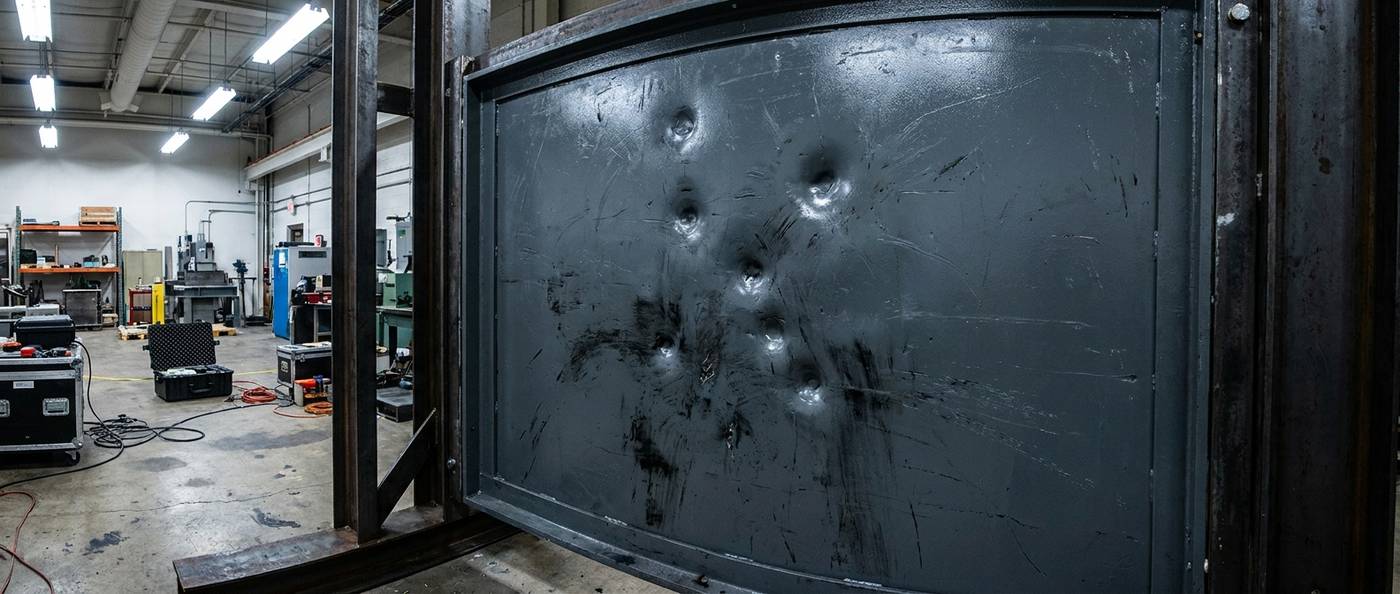
The red flags
- “FEMA approved” or “FEMA certified.” No such status exists. The NSSA specifically warns that a product should not make this claim.
- Certification with nothing behind it. If a shelter is not NSSA sealed and verified, its certification is only as good as the manufacturer's word.
- No drawings offered. You should be able to see how the unit was tested and what it was approved with.
- Generic replacement parts. Anchors, hinges and door hardware were part of the tested assembly. Substitutes invalidate the assumption the rating rests on.
- Price far below the ranges on the cost page. Something has been left out, and it is usually the door.
Why the door is where this gets serious in Arkansas
On 27 April 2014, an EF4 tornado tracked 41.1 miles through Pulaski, Faulkner and White counties, reaching maximum intensity in Faulkner County as it crossed Interstate 40 at Mayflower and moved through Vilonia. Sixteen people were killed. One of those deaths occurred inside an above-ground storm shelter, when a hard object struck the shelter door and caused it to deform excessively into the shelter.
That is a hard fact to include on a page selling shelters, and it belongs here anyway. Shelters overwhelmingly work — but the rating on the brochure is only worth what the testing behind the door assembly is worth. Ask for the documentation. A manufacturer who has done the work will hand it over without hesitation.